







THE ARCHIVES OF AURELYA
Choose a Direction of Knowledge
Selected direction
Phenomena and Structures

Record
The Aurelyan Way of Building
On Aurelya, building does not usually mean removing nature and erecting a separate structure in its place. Structures are grown as part of the environment.
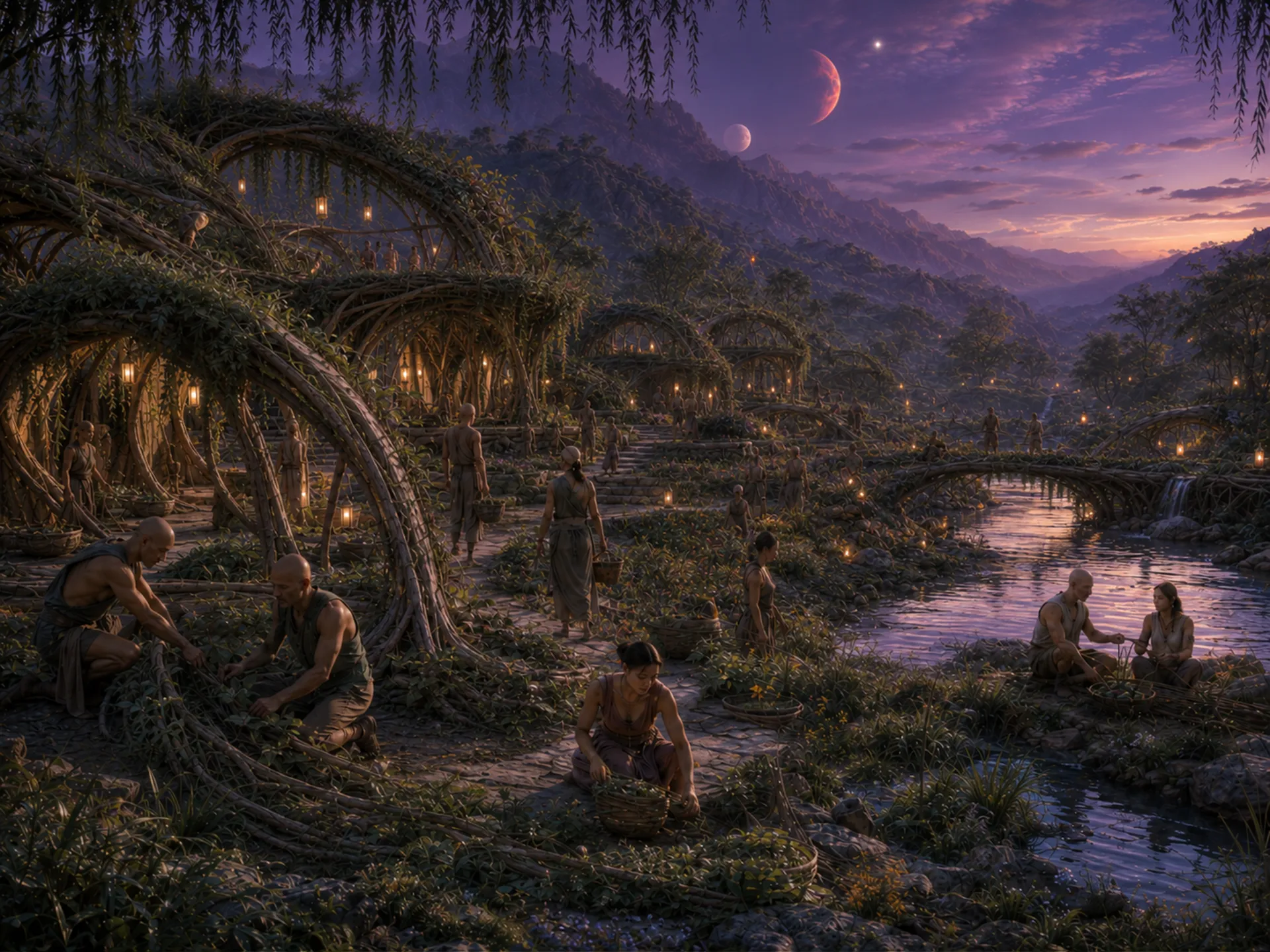
The Millennium of Silence was not a period of stagnation. The environment was guided to grow into dwelling arches, pathways, and shared spaces needed by communities.

The Home of Ialyr and Thaeris
The homes created for Aija and Sigrid — by then Ialyr and Thaeris — showed that Aurelyan building could also respond to a deeply individual need.
When Ialyr and Thaeris first settled in the Guest Arc, a home was grown for them where they could withdraw, if they wished, from the constant presence of Shared Harmony. It was not a structure that shut the community out, but Shared Harmony responding to the individual need of two people from Earth and giving that need its own space.
\n
In the end, they rarely used the possibility of complete withdrawal. The permanent home later grown for them was, in every essential respect, an ordinary Aurelyan home: open to its environment and to shared resonance, yet unmistakably their own.
\n
Objects brought from Earth made it personal. Sigrid’s old field notebook, Aija’s luminous guitar pick, a photograph of Aija’s mother, and a group photograph from the Lofoten shore kept a small trace of the world they had left behind. For Oskari and Ingrid, visiting the home, those objects made the change between two galaxies suddenly tangible.

Vaelen at twilight. On present-day Aurelya, grown structures and bioluminescence belong to the environment so completely that illuminated architecture does not form a separate layer from nature.

The home of Ialyr (Aija) and Thaeris (Sigrid) is clearly Aurelyan: calm, understated, and shaped by shared harmony. Only a few objects brought from Earth speak of their other home. In the image, Oskari and Ingrid have arrived from Earth for an important celebration and are visiting their home for the first time.
On Aurelya, building does not usually mean removing nature and erecting a separate structure in its place. Structures are grown as part of the environment.
The growth and shaping of plants, and even some kinds of stone, are guided according to a future need. In this way, dwelling arches, bridges, paths, teaching places, shared terraces, and other structures emerge without interrupting the landscape, but continuing it.
This principle has belonged to Aurelyan life since its earliest periods. Building is therefore closer to growth guided toward a purpose than to conventional construction on Earth.
Living Structures on Present-Day Aurelya
On present-day Aurelya, building is an even freer form of cultivation than it was in earlier ages. Aurelyans give a structure direction and purpose, while its final form emerges through the shared resonance of plants, adaptable kinds of stone, and the surrounding life.
\n
A structure is therefore not simply forced into a predetermined shape. The environment itself participates in what it becomes. The same shared resonance connects it with surrounding vegetation, water, paths, and the needs of the community.
\n
Light, too, has become part of this growth. Aurelyan nature is widely bioluminescent, and structures can be grown so that living light develops with them. When darkness falls, homes, bridges, and paths do not appear as separately illuminated buildings, but as part of the planet’s own glow.
The Early Eras
In early Aurelya, Shared Harmony was neither a completed system nor a doctrine. It was a developing capacity and a condition of life in which Aurelyans lived in a close, almost symbiotic relationship with their surroundings.
\n
Even then, it was understood in practice that a being was not completely separate from the place in which they lived. Emotion, movement, and vibration left traces in the environment, and the environment responded. Many principles that would later be named as fundamental to Aurelya arose from this way of life long before resonance became an organized field of study.
The Millennium of Silence
The Millennium of Silence was a period of withdrawal, listening, and restraint in the use of resonance. The use of Shared Harmony was slowed, and Aurelya began to develop practices in which a first feeling or interpretation was not immediately reinforced into a shared reality.
\n
Silence did not mean that life stopped. New communities continued to form, places changed, and life continued to grow. Structures that would eventually lead toward the later form of Vaelen also began to emerge gradually.
\n
Building on Aurelya did not mean clearing nature away and placing a structure in its place. Natural growth was guided toward a purpose. The living environment could develop into dwelling arches, bridges, pathways, places of learning, meeting terraces, and other structures needed by a community. Building was therefore part of the same relationship with the environment in which Aurelyans had lived since the earliest eras.
\n
This was not yet the age of Aurelya’s high culture. The mature social and intellectual whole recognizable today formed only several millennia later.
The Home of Ialyr and Thaeris
The homes created for Aija and Sigrid — by then Ialyr and Thaeris — showed that Aurelyan building could also respond to a deeply individual need.
When Ialyr and Thaeris first settled in the Guest Arc, a home was grown for them where they could withdraw, if they wished, from the constant presence of Shared Harmony. It was not a structure that shut the community out, but Shared Harmony responding to the individual need of two people from Earth and giving that need its own space.
\n
In the end, they rarely used the possibility of complete withdrawal. The permanent home later grown for them was, in every essential respect, an ordinary Aurelyan home: open to its environment and to shared resonance, yet unmistakably their own.
\n
Objects brought from Earth made it personal. Sigrid’s old field notebook, Aija’s luminous guitar pick, a photograph of Aija’s mother, and a group photograph from the Lofoten shore kept a small trace of the world they had left behind. For Oskari and Ingrid, visiting the home, those objects made the change between two galaxies suddenly tangible.
Subcategory