








THE ARCHIVES OF AURELYA
Choose a Direction of Knowledge
Selected direction
Worlds and Places
Basic Information
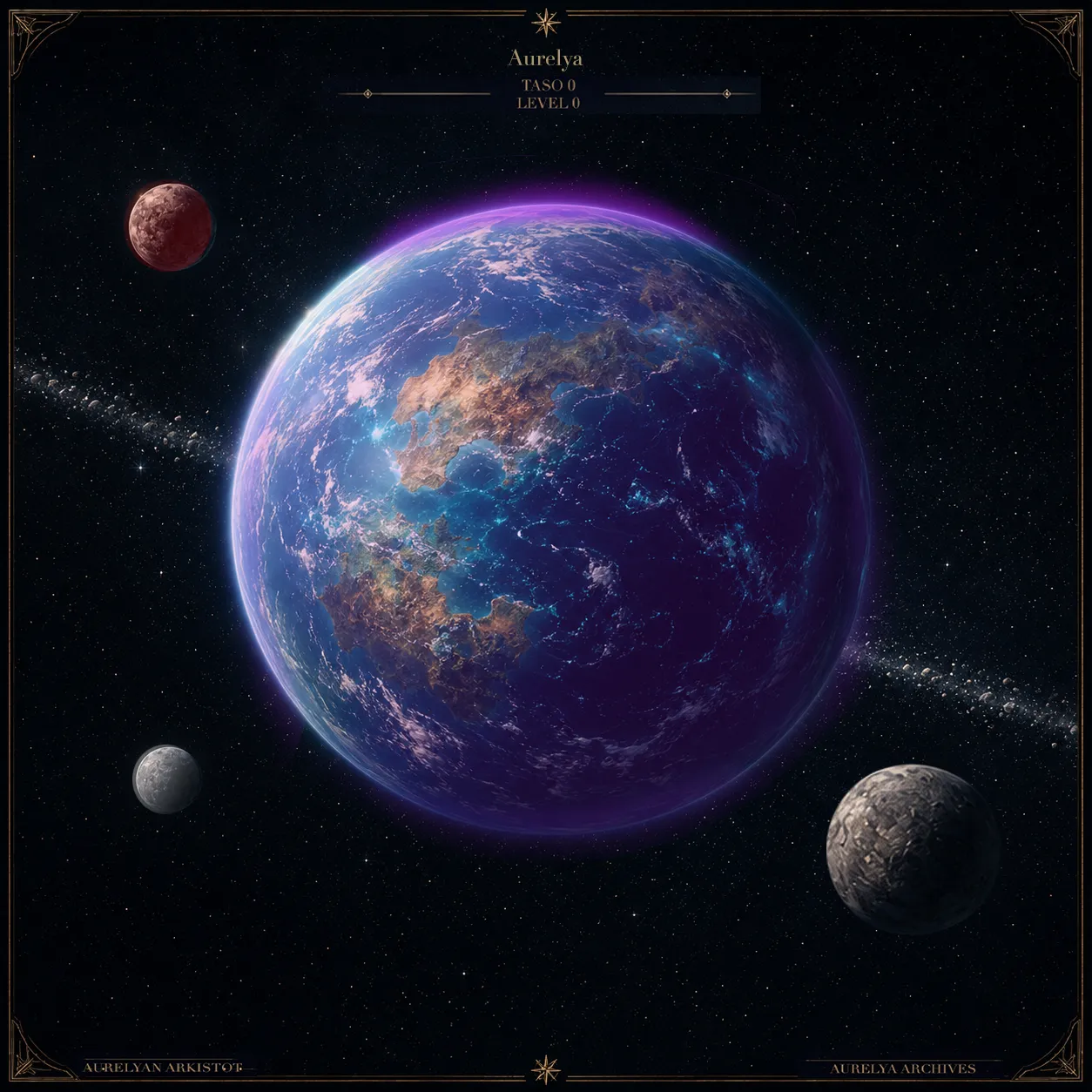
Aurelya is a living planet in the Andromeda Galaxy and the fifth world of the Tharae star system. Its ocean-dominated surface, oxygen-rich atmosphere, stable climate, and system of three moons have allowed diverse life to develop over a long period of time.
- System
- Tharae star system
- Position in the system
- Fifth planet
- Diameter
- Approximately 1.08 times Earth's diameter
- Surface gravity
- Slightly lower than Earth's
- Length of day
- 26 Earth hours
- Orbit around Tharae
- 412 Aurelyan days [approximately 1.22 Earth years]
- Ocean coverage
- Approximately 72 percent of the surface
- Atmosphere
- Oxygen-rich
- Moons
- Elior, Nyxa, and Cael
A Living Ocean World
Aurelya is slightly larger than Earth, but its surface gravity is somewhat lower. Extensive ocean coverage, an oxygen-rich atmosphere, and a stable energy balance create an environment in which complex life has been able to develop over long periods of time.
Aurelya's climate is stable overall, but not unchanging. Its oceans and cloud systems moderate large variations. The influence of its three moons can be seen in the tides, the stability of the planet's axis, and its long natural rhythms.
Nature and Inhabitants
Much of Aurelya's natural environment is shaped by the sea. Coasts, lagoons, islands, and shallow waters form interwoven habitats. The shoreline is not a sharp boundary between land and water, but a transitional zone where vegetation, light, movement, and life meet.
The inhabitants of the planet are Aurelyans. From a human perspective, some of their features are recognizable, but they are not human and are not a variation of humanity. Their biology and sensory world evolved under Aurelya's own conditions of light, sea, and gravity.
Resonance is one of the fundamental concepts of Aurelya's natural world and life. At this Archive Level, it is treated as an observable relationship and phenomenon, rather than as an explanation of its underlying mechanism.
Elior, Nyxa, and Cael
Aurelya's three moons influence the planet's tides, axial stability, and long-term rhythms. They are also worlds in their own right, each with its own record.
Record details
Origin: Astronomical observational data predating the Vaelen era.
The original recorder and exact date cannot be identified at this Archive Level.
Confirmed by: Vaelir, Vaelen era cycles 2–3.
Reviewed by: Saeliri, Vaelen era cycle 6469.
General Appearance
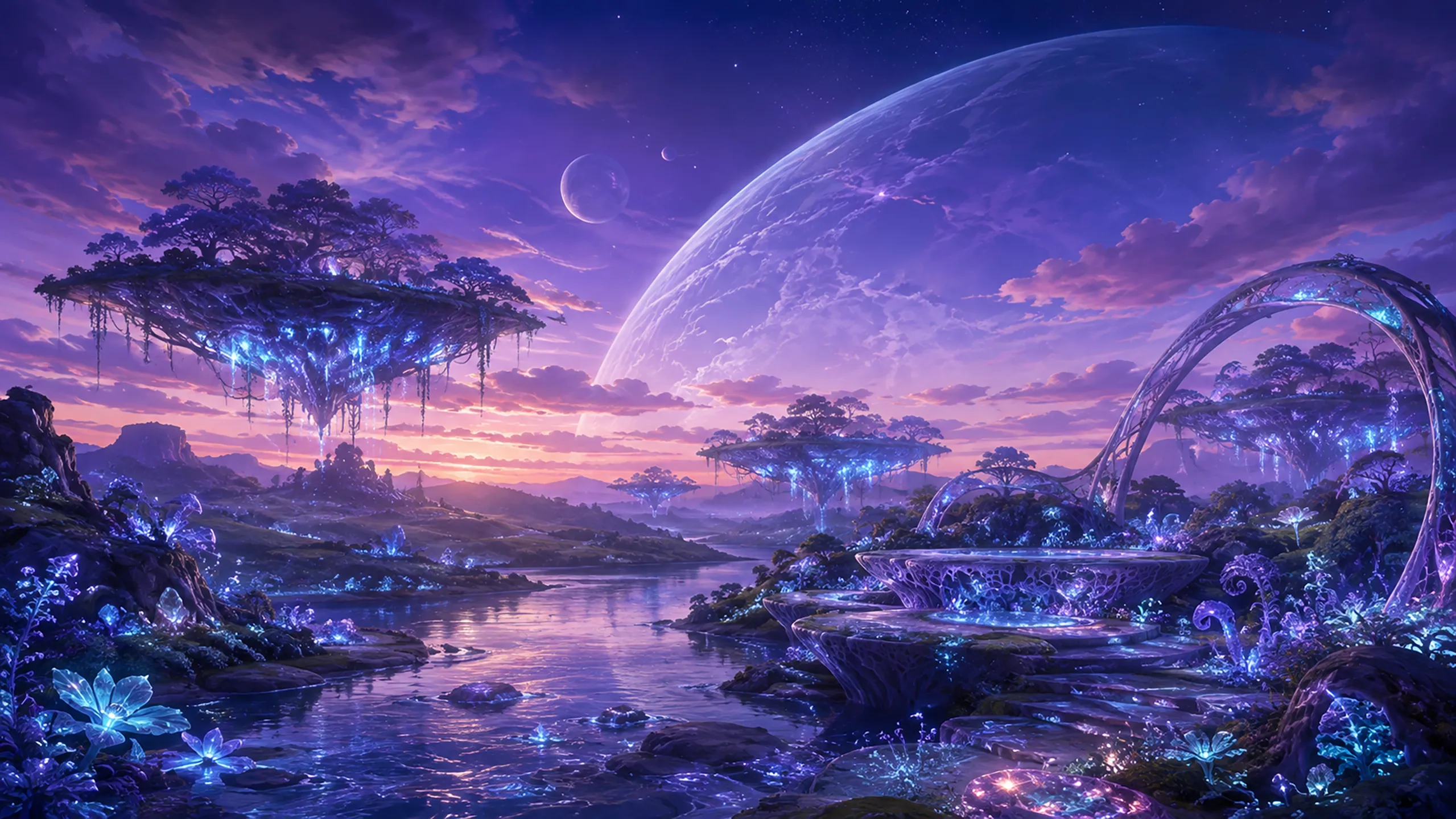
Aurelya is known for its violet sky, silver-gray clouds, and a twilight that never fully fades. As daylight recedes, the world begins to glow with its own natural light.
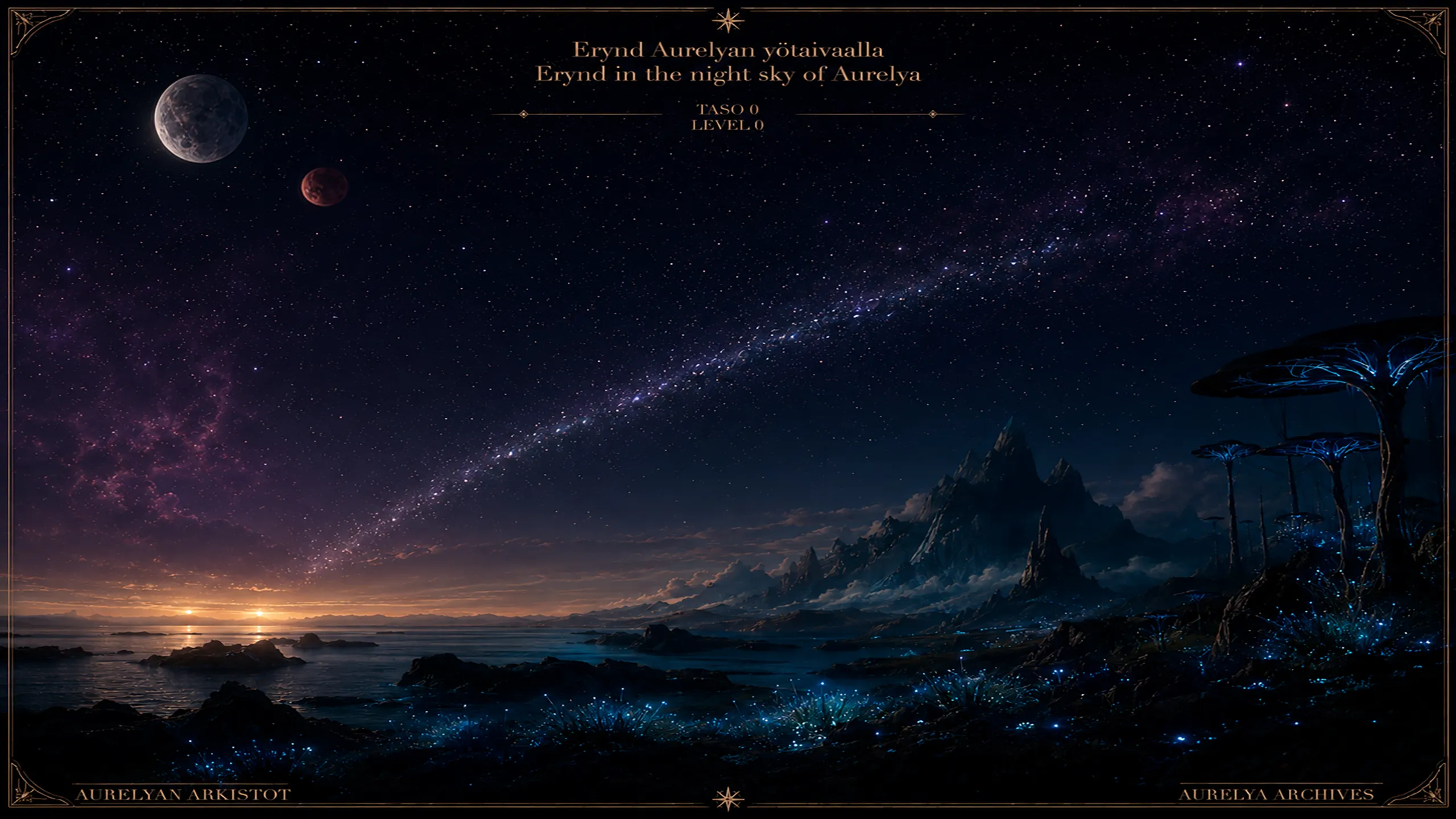
Tharae's light is refracted through Aurelya's daytime sky in pale violet hues. As evening approaches, the color of the sky deepens, and Elior, Nyxa, and Cael may rise alongside Tharae and Thalos.
In deeper twilight, the ice and rock bodies in the outer regions of the Tharae system may also appear across the sky as a long, faint band.
Complete darkness is rare on Aurelya. Plants, animals, and even some stones produce light of their own. Bioluminescence can blend the forms of the landscape so seamlessly that it is not always clear where a plant ends, a stone begins, or a small creature moves between them.
Rain occurs on Aurelya, but the planet does not experience the powerful storms familiar from Earth.
Among Aurelya's characteristic phenomena are its floating forest islets. They do not drift high in the sky, but rise gently above the water or ground. Along rivers, there may be platforms used for teaching and gathering, as well as the gently curving light-arches of dwellings. These, too, do not appear to be buildings: their forms seem to have grown, or been grown, for their intended purpose.
Record details
Recorded by: Caelel.
Vaelen era cycle 5468.098.
Moons and the Sea
Because Aurelya has three moons, the sea is also the most visible surface of their influence. The tides are not shaped by a single dominant rhythm, but by an interwoven pattern of overlapping effects. This makes the sea a constantly changing, but not chaotic, system. The influence of Elior, Nyxa, and Cael can be felt in the sea's different movements, cycles, and patterns of light.
For this reason, the sea also serves as a visible expression of time and change. The influence of the moons is not merely an astronomical phenomenon, but part of the cultural experience. Along coasts, on islands, and at the water's edge, these rhythms become especially apparent, and observing them is part of Aurelya's long memory.
Record details
Recorded by: Caelel.
Vaelen era cycle 5468.234.
Revised by: Caelel, Vaelen era cycle 5468.235.
Main category