








THE ARCHIVES OF AURELYA
Choose a Direction of Knowledge
Selected direction
History and Events

Record
Aurelya’s History — in a Glowing Nutshell
Aurelya’s history is a long story of gradual change, growing communities, and the way connection with the environment slowly became a conscious responsibility.
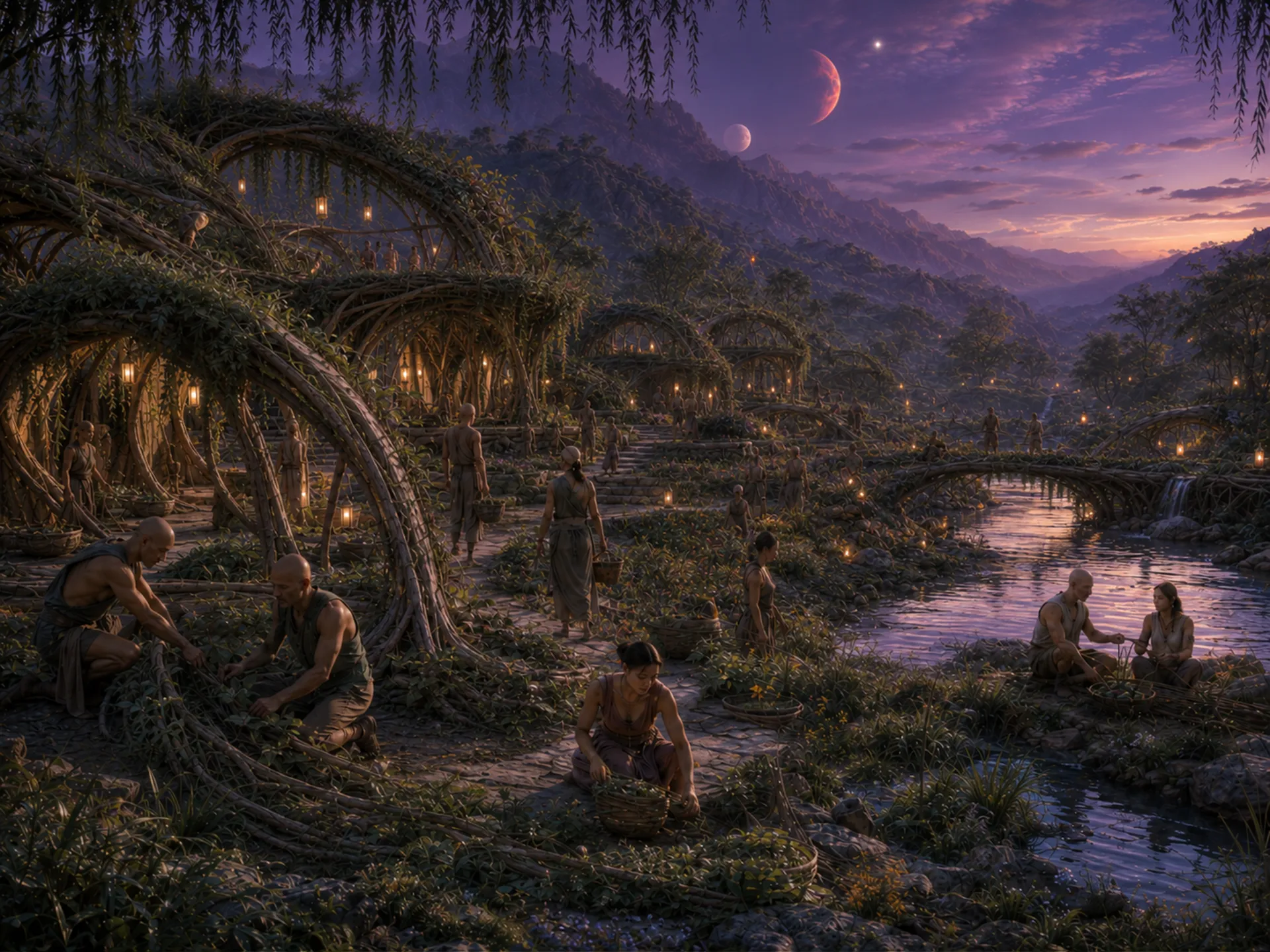
The Millennium of Silence was not a period of stagnation. The environment was guided to grow into dwelling arches, pathways, and shared spaces needed by communities.
Aurelya’s history is a long story of gradual change, growing communities, and the way connection with the environment slowly became a conscious responsibility.
Aurelya’s past cannot be described simply as a sequence of events and dates. Many of its greatest changes emerged slowly over generations, as communities learned to listen to their surroundings, to one another, and to the effects of their own resonance.
\n
The earliest eras, the expansion of resonance, the Millennium of Silence, and the long period of modern history that followed form the main lines of this development. Aurelya was not a high culture in its present form throughout all of this time. The ethical, intellectual, and social structures now associated with Aurelya reached their mature form only much later.
The Early Eras
In early Aurelya, Shared Harmony was neither a completed system nor a doctrine. It was a developing capacity and a condition of life in which Aurelyans lived in a close, almost symbiotic relationship with their surroundings.
\n
Even then, it was understood in practice that a being was not completely separate from the place in which they lived. Emotion, movement, and vibration left traces in the environment, and the environment responded. Many principles that would later be named as fundamental to Aurelya arose from this way of life long before resonance became an organized field of study.
The Era of Expanding Resonance
Gradually, Aurelyans learned to use Shared Harmony more consciously. Relationships between places, beings, and communities began to form recognizable structures, and communities found their own ways of settling into their environments.
\n
The same development also revealed the more difficult side of connection. What strengthened understanding and the common good could also amplify fear, rejection, and certainty formed too quickly. Aurelya gradually had to learn that a powerful connection is not, by itself, the same thing as a correct interpretation.
The Millennium of Silence
The Millennium of Silence was a period of withdrawal, listening, and restraint in the use of resonance. The use of Shared Harmony was slowed, and Aurelya began to develop practices in which a first feeling or interpretation was not immediately reinforced into a shared reality.
\n
Silence did not mean that life stopped. New communities continued to form, places changed, and life continued to grow. Structures that would eventually lead toward the later form of Vaelen also began to emerge gradually.
\n
Building on Aurelya did not mean clearing nature away and placing a structure in its place. Natural growth was guided toward a purpose. The living environment could develop into dwelling arches, bridges, pathways, places of learning, meeting terraces, and other structures needed by a community. Building was therefore part of the same relationship with the environment in which Aurelyans had lived since the earliest eras.
\n
This was not yet the age of Aurelya’s high culture. The mature social and intellectual whole recognizable today formed only several millennia later.
The Long Balance of Modern History
After the Millennium of Silence, Shared Harmony gradually took on more organized forms. Early structures of the Council became stronger, concords developed, and responsibility between communities began to be carried more consciously. Aurelya’s modern history is considered to begin about six thousand years before the present.
\n
Aurelya begins to appear as a fully developed high culture only around 2,000–3,000 years before the present, when its ethical, intellectual, and social structures had matured close to their current form.
\n
Aurelyan historiography is not built around great individuals. A single Aurelyan may influence events decisively, but the name does not usually become greater than the event itself. In the Archive, individuals become visible when their actions, thoughts, or consequences help explain the larger whole.
Subcategory